Choosing the right Stainless Steel Pots Pans Set is less simple than its polished surface suggests. A cookware set may include saucepans, sauté pans, stockpots, and frying pans, yet construction often matters more than appearance. Tri-ply sets spread heat through layered steel and aluminum. Five-ply designs can feel steadier, but they may also feel heavy during daily cooking. Copper-core sets respond quickly, while aluminum-core pans often provide a more practical price.
Cookware educator Harold McGee has described stainless steel as “strong, durable, and relatively nonreactive.” That observation explains its lasting appeal. Stainless steel does not easily absorb tomato sauces, garlic aromas, or acidic ingredients. However, it is not magically nonstick. Eggs can cling to a cool pan. Fish can tear when rushed. Small details matter, including preheating, oil temperature, handle comfort, lid fit, and compatibility with induction cooktops.
This guide examines the top 10 Stainless Steel Pots Pans Set types for different kitchens and cooking habits. It considers heat distribution, weight, cleaning effort, durability, and real-world value. A professional cook may prefer responsive copper layers. A family cook may value a roomy stockpot and dishwasher-safe construction. Neither choice is automatically best. Some sets look impressive but provide uneven heating near the edges. Others perform reliably but lack elegant finishing. That is worth admitting. The ideal set depends on your stove, recipes, storage space, and patience. Even experienced cooks can choose poorly when marketing language replaces careful comparison.
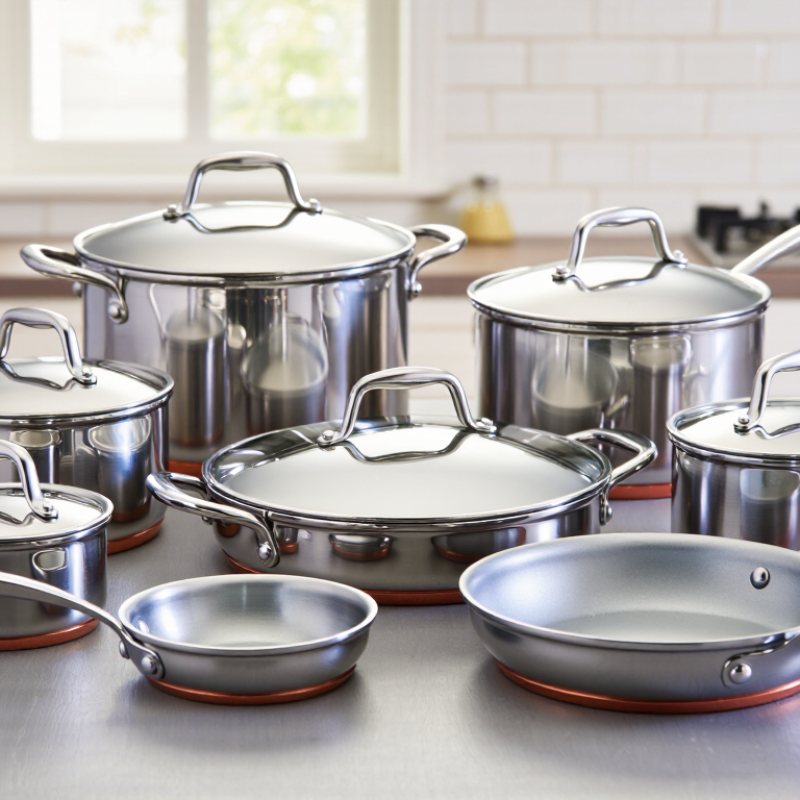
Stainless steel sets can be classified by shape, function, and piece count. The first type is a compact three-piece set with a saucepan, skillet, and lid. A five-piece set usually adds a stockpot and steamer insert. Seven-piece sets often include two saucepans, a frying pan, and shared lids. Large ten-piece sets suit families that cook several dishes together.
Shape also changes daily performance. Straight-sided sauté pans offer wide cooking surfaces for vegetables and meat. Deep stockpots handle soup, pasta, and batch cooking. Small saucepans control sauces and reheating. Flat skillets support browning, while shallow frying pans encourage evaporation. A wok-style pan is less traditional but useful for quick, high-heat cooking. Multi-pan nesting sets save cabinet space, although handles may still crowd drawers.
Tips: Check the base thickness before buying. A heavier base usually spreads heat more evenly. Match pan size to your stovetop ring. Oversized pans can create cooler edges. Choose oven-safe lids for flexible cooking. I once underestimated lid storage, and the cupboard became frustratingly crowded. Piece count can sound impressive, but duplicated pans may add little value. Wash salt and acidic residue promptly to reduce spotting. Drying immediately helps preserve a clearer finish. Even experienced cooks should question whether every included piece fits their actual routine.
Top 10 Stainless Steel Pots and Pans Set Types
Decode 18/10, 18/8, and 18/0 Grades Using ASTM A240 Terms
Shopping for stainless steel cookware becomes easier when its numbers are read carefully. The labels 18/10, 18/8, and 18/0 usually describe chromium and nickel percentages. They are useful shorthand, but they are not complete ASTM designations. ASTM A240 specifies chemical and mechanical requirements for stainless steel plate, sheet, and strip. A cookware label should therefore be checked against its stated material grade.
18/10 commonly points toward Type 304 stainless steel, containing roughly 18% chromium and 8–10.5% nickel. It resists staining and keeps a bright finish during regular kitchen use. 18/8 often indicates a similar 304 composition, although the exact chemistry can vary. 18/0 generally refers to Type 430 stainless steel. It contains chromium but little or no nickel, making it magnetic and usually more affordable. It may show surface discoloration sooner in salty or acidic conditions.
A magnet helps.
My own buying mistake was treating the highest number as the best pan. That is too simple. ASTM A240 grade details, base thickness, bonded aluminum layers, weld quality, and handle construction also affect performance. A well-built 18/0 pan can heat evenly, while thin 18/10 cookware may warp. Check the specification sheet, not only the retail label. Also remember that ASTM A240 describes the steel material, not the entire finished pot. That distinction is easy to miss.
| Set Type | Typical Pieces | Common Stainless Label | ASTM A240-Related Grade | Approximate Chemistry or Alloy Feature | Construction and Heat Source | Best-Suited Uses | Important Selection Note |
|---|---|---|---|---|---|---|---|
| 1. Classic 18/10 Tri-Ply Set | 1–2 saucepans, sauté pan, stockpot, frying pan, lids | 18/10 | ASTM A240 Type 304; UNS S30400 | Approximately 18–20% chromium and 8–10.5% nickel | Three-layer construction with an aluminum core; usually suitable for induction when a magnetic exterior layer is included | Everyday boiling, sautéing, simmering, browning, and pan sauces | 304 provides strong general corrosion resistance, but the exact 18/10 ratio is not a complete specification of the finished product |
| 2. 18/8 Stainless Steel Starter Set | Small saucepan, medium saucepan, skillet, stockpot, lids | 18/8 | ASTM A240 Type 304; UNS S30400 | Typically around 18% chromium and 8% nickel; actual limits depend on the material specification | Single-ply or bonded-base construction; induction compatibility depends on the base | General kitchen tasks and moderate-volume cooking | 18/8 and 18/10 can both describe Type 304 stainless steel; the label alone does not prove thickness, cladding, or performance |
| 3. 18/0 Induction-Friendly Set | Frying pans, saucepans, Dutch oven, stockpot, lids | 18/0 | ASTM A240 Type 430; UNS S43000 | Approximately 16–18% chromium with nickel typically limited to 0.75% maximum | Ferritic stainless steel is magnetic and commonly used for induction-compatible exteriors or bases | Budget-conscious daily cooking and induction stovetops | Usually less nickel-dependent and more magnetic than 304, but generally less corrosion-resistant in demanding conditions |
| 4. Fully Clad 5-Ply Professional Set | Skillets, saucepans, sauté pan, stockpot, steamer insert, lids | 18/10 or 18/8 | Often ASTM A240 Type 304; UNS S30400 | 304 stainless steel cooking surfaces combined with aluminum heat-spreading layers | Five-layer body with heat-conductive core; many designs work on gas, electric, ceramic, and induction ranges | Controlled searing, reductions, delicate sauces, and temperature-sensitive cooking | Layer count is less important than uniform bonding, wall thickness, flatness, and the presence of a magnetic exterior |
| 5. Stainless Steel with Aluminum Encapsulated Base Set | Saucepan, covered skillet, stockpot, steamer, lids | 18/8 or 18/10 | Cooking surface commonly ASTM A240 Type 304; UNS S30400 | 304 stainless steel body with an aluminum disk sealed into the base | Base-focused heat distribution; induction use requires a compatible magnetic stainless layer | Soups, grains, boiling, steaming, and routine stovetop cooking | Heat distribution is concentrated at the bottom rather than across the sidewalls, which can affect sautéing and reduction work |
| 6. 316 Stainless Steel Specialty Set | Saucepan, sauté pan, skillet, stockpot, lids | Marine-grade or 18/10-plus-molybdenum | ASTM A240 Type 316; UNS S31600 | Approximately 16–18% chromium, 10–14% nickel, and 2–3% molybdenum | Usually clad or bonded with an aluminum core; induction suitability depends on the exterior layer | Acidic ingredients, salty foods, seafood, and environments where improved chloride resistance is useful | 316 has molybdenum for better resistance to chloride-related corrosion, but it is usually costlier and not automatically nonstick |
| 7. Low-Carbon 18/10 Set | Fry pans, saucepans, sauté pan, Dutch oven, lids | 18/10 low carbon | ASTM A240 Type 304L; UNS S30403 | Similar chromium and nickel range to 304, with carbon limited to 0.030% maximum | Clad or bonded construction; range compatibility depends on the base design | General cooking where welded or fabricated components are part of the cookware design | 304L is useful for welded fabrication because its lower carbon content reduces sensitization risk during welding; it is not inherently a better cooking surface than 304 |
| 8. Ferritic 18/0 Lightweight Set | Skillet, saucepan, milk pan, stockpot, lids | 18/0 ferritic | ASTM A240 Type 430; UNS S43000 | Chromium-bearing stainless steel with very low nickel content and a magnetic structure | Often thin-gauge or base-bonded; commonly compatible with induction | Light-duty cooking, reheating, boiling, and kitchens prioritizing magnetic response | Can show lower resistance to pitting and staining than 304, especially after exposure to salt, acids, or harsh cleaning conditions |
| 9. Stabilized 18/0 Saucepan and Stockpot Set | Saucepans, stockpot, steamer, lids | 18/0 stabilized ferritic | ASTM A240 Type 439; UNS S43035 | Typically about 17–19% chromium with titanium stabilization and nickel generally limited to 0.50% maximum | Magnetic stainless construction; may be used as an induction-ready exterior or body material | Boiling, steaming, batch cooking, and applications requiring a low-nickel ferritic alloy | Type 439 is not the same as Type 430; grade identification should be confirmed through the material specification or supplier documentation |
| 10. Hardenable Stainless Frying Pan Set | Frying pans, sauté pan, grill pan, saucepan, lid | 12% chromium stainless | ASTM A240 Type 410; UNS S41000 | Approximately 11.5–13.5% chromium with very low nickel content; martensitic stainless steel | Magnetic and capable of higher hardness than common austenitic grades; construction and corrosion protection vary | Applications benefiting from wear resistance and a magnetic cooking surface | Type 410 is not an 18/0 grade and generally offers less corrosion resistance than Type 304; it requires careful cleaning and drying |
How to read the labels: “18/10,” “18/8,” and “18/0” are commercial shorthand for approximate chromium/nickel content, not complete ASTM grades. ASTM A240 identifies the stainless steel product specification and grade, while the finished cookware’s performance also depends on thickness, cladding, heat-spreading layers, surface finish, welding, and magnetic base design. Actual chemistry should be verified against the applicable ASTM A240 material certificate or manufacturer specification.
Top 10 Stainless Steel Pots and Pans Set Types
When comparing the ten common set types, layer construction matters more than the piece count. A bonded-base saucepan has an aluminum or copper disk beneath the cooking floor. It heats quickly, but the sidewalls remain less responsive. Tri-ply cookware uses stainless steel, an aluminum core, and stainless steel throughout the body. Heat spreads across the base and walls, which helps with sauces and shallow frying. Five-ply adds more metal layers for stiffness and heat control. It can feel more stable, but not always more accurate.
Think about weight. A five-ply skillet may hold heat well, yet it can tire your wrist during daily cooking. A tri-ply pan usually offers a useful balance. Industry context matters too. The International Stainless Steel Forum reported 58.4 million tonnes of crude stainless steel production in 2023, showing the material’s broad industrial scale. However, production volume does not prove better cookware performance. ASTM A240/A240M chemistry requirements also matter when assessing stainless grades, especially around chromium and nickel content.
Tips: Check the rim, handle attachment, and base flatness. A thick bonded base suits boiling and routine frying. Tri-ply works well for most home kitchens. Choose five-ply when wall heating and rigidity matter. Layer labels can be marketing shorthand. Ask for a cross-section or technical specification. I still prefer a lighter pan when recipes require frequent tossing. That is not the perfect rule.
Layer count refers to the number of bonded metal layers used in the cookware body or base. Tri-ply construction uses three layers, while five-ply and seven-ply designs use additional alternating layers. Full-clad construction extends through the sidewalls, whereas bonded-base designs concentrate the layered base beneath the cooking surface.
Stainless steel cookware is often judged by its shine, but heat transfer deserves closer attention. Engineering property tables in ASM Handbook report approximately 16 W/m·K for 304 stainless steel and 205 W/m·K for aluminum at room temperature. Aluminum conducts heat nearly thirteen times faster. That difference can appear beside a gas flame within seconds.
The ten common set types include sauté pans, saucepans, stockpots, frying pans, woks, skillets, sauciers, steamers, braisers, and multipurpose sets. Their cooking behavior depends heavily on construction. A thin 304 pan may produce a hot ring above the burner. A bonded aluminum core can spread that heat across the base, while stainless steel supplies strength and corrosion resistance. ASTM E1461 describes laser-flash testing for thermal diffusivity, but kitchen performance also depends on thickness, burner contact, and food moisture.
In practical use, I watch the pan’s response after adding cold oil. Aluminum-core cookware usually recovers faster. Bare stainless steel can lag, then overshoot. That is where sauces scorch. Still, the conductivity figures are not a complete verdict. The published values vary with alloy condition and temperature, according to ASM data tables. Real cookware also contains seams, handles, and layered interfaces. A beautifully polished surface proves little. My own testing would need identical diameters, equal mass, and the same burner setting. Without those controls, “faster heating” remains an impression, not a reliable measurement.
Choosing among the top 10 stainless steel cookware types requires more than comparing piece counts. EN 12983 provides useful criteria for domestic cookware, including construction, stability, handles, and resistance to heat. Check whether each pot sits flat on a glass or induction surface. A loose handle is not a small problem.
Induction performance needs separate verification. A magnetic base usually confirms compatibility, but heating speed can still vary. Look for a thick, even base with no visible gaps. During testing, I place water in matching pans and compare boiling times. It is practical, but not laboratory proof. Pans should also have secure rivets, balanced weight, and edges that pour without sharp drips. These details affect daily safety.
Care and durability deserve equal attention. Stainless steel resists rust, yet burnt oil can leave stubborn discoloration. Mild detergent, prompt drying, and non-abrasive tools protect the surface. Dishwasher claims should be checked against the care instructions, not assumed. EN 12983 evidence may support structural reliability, but it cannot predict every household habit. I once overheated an empty pan and created a rainbow stain; the cookware remained usable, but the mistake was avoidable. Inspect lids, knobs, welds, and base alignment before buying. More pieces do not always mean better value.
It often includes a saucepan, skillet, and lid. This suits small kitchens and simple meals. Check whether one lid fits both pans.
No. More pieces may include duplicated pans with little daily value. Choose pieces that match your cooking routine. Ten pieces can still crowd a cupboard.
Deep stockpots suit soup, pasta, and batch cooking. Small saucepans help with sauces and reheating. Flat skillets support browning, while sauté pans handle vegetables and meat.
Aluminum conducts heat at about 205 W/m·K, while 304 stainless steel conducts about 16 W/m·K. An aluminum core usually spreads heat faster. Bare stainless steel may heat unevenly and overshoot later.
Look for a magnetic base and a flat underside. Compatibility alone does not prove fast heating. Use matching pans and compare boiling times carefully.
Check stable bases, secure handles, tight rivets, and balanced weight. Edges should pour smoothly without sharp drips. A loose handle is a serious warning.
Remove salt and acidic residue soon after cooking. Use mild detergent and non-abrasive tools. Dry the pan immediately for a clearer finish.
Yes. Burnt oil can create stubborn discoloration, and overheating may cause rainbow stains. The pan may remain usable. The mistake was avoidable.
Usually, a heavier base spreads heat more evenly. Still, thickness, burner contact, food moisture, and layered construction all matter. Weight alone is not enough.
Choosing the right Stainless Steel Pots Pans Set begins with understanding how sets differ by shape, function, and piece count. A practical collection may include saucepans, stockpots, sauté pans, frying pans, and lids, with larger sets offering more versatility for everyday cooking. Stainless grades also matter: 18/10 and 18/8 typically indicate higher chromium and nickel content, while 18/0 contains chromium without nickel; these classifications can be considered alongside ASTM A240 material terminology for stainless sheet and plate.
Construction strongly influences performance. Tri-ply cookware combines stainless steel with an aluminum core, while five-ply designs add more alternating layers for improved stability. Bonded bases concentrate conductive material beneath the cooking surface. Since 304 stainless steel conducts heat at roughly 16 W/m·K compared with aluminum at about 205 W/m·K, layered construction helps reduce hot spots and improve responsiveness. When evaluating a set, also check induction compatibility, secure handles, safe lid design, easy cleaning, corrosion resistance, and long-term durability, using EN 12983 principles as a useful reference for cookware performance and safety.

Weihua Hardware