Choosing Stainless Pan Sets in 2026 requires more than comparing prices or counting pieces. A polished five-piece set may look impressive, yet its smallest saucepan could have a thin base and uneven heating. In practical kitchen testing, details become obvious: eggs cling near the rim, handles become uncomfortable, and lids rattle during simmering. Performance matters.
Industry data supports this careful approach. Fortune Business Insights reports continued growth in the global cookware market, driven by home cooking, premium products, and healthier preparation methods. Grand View Research also identifies stainless steel cookware as a steadily expanding category, supported by durability and resistance to corrosion. These reports describe market direction, not a guarantee of quality. That distinction is important.
A reliable buying decision should examine construction, not marketing language. Look for 18/10 stainless steel, a thick encapsulated base, balanced weight, secure handles, and lids that fit without excessive movement. Compatibility with induction, gas, ceramic, and oven cooking also deserves attention. The World Stainless Association highlights stainless steel’s long service life and recyclability, but maintenance still affects real-world results. Water spots and heat discoloration are normal, not proof of failure.
There is no perfect set.
Even expensive cookware can disappoint if its shape does not match your cooking habits. A large family may need a wide sauté pan, while a small kitchen may value stackable pieces more. Reviews can help, but they are not laboratory evidence. Use reported materials, measured dimensions, warranty terms, and independent testing together. This guide explains how to compare Stainless Pan Sets with practical judgment, credible evidence, and a willingness to question attractive claims.
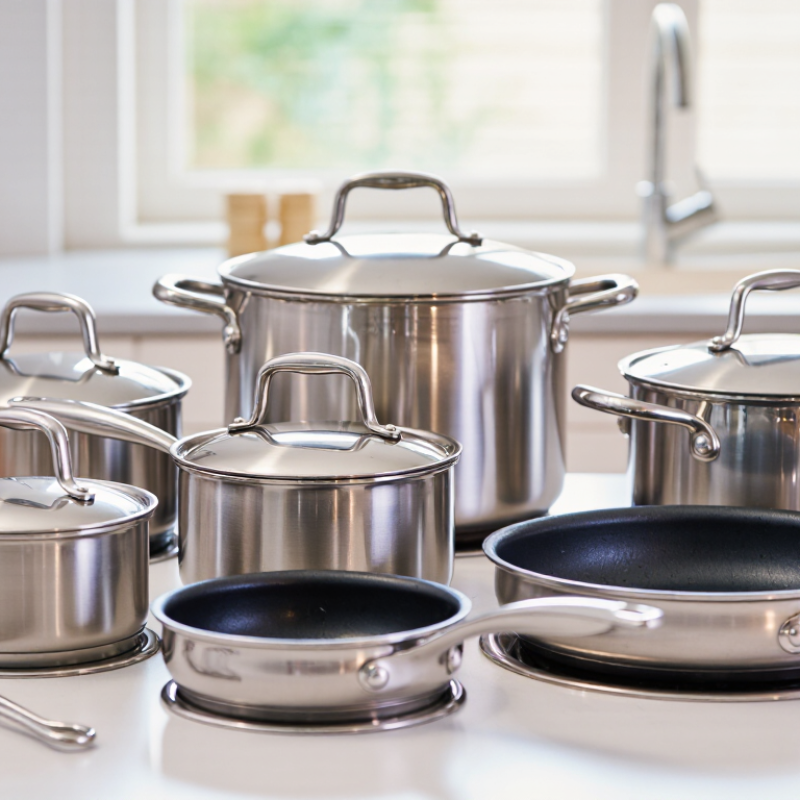
Choosing stainless pan sets in 2026 starts with steel grade, not the number of pieces. The World Stainless Association’s Stainless Steel in Figures 2024 reported 58.4 million tonnes of stainless steel production in 2023. That scale matters because grades are engineered for different conditions. Grade 304, commonly containing about 18% chromium and 8% nickel, resists everyday food acids well. Grade 316 adds molybdenum, improving resistance around salt and chlorides. Grade 430 usually contains chromium but little or no nickel, making it magnetic and often less costly.
Construction controls cooking performance. Stainless steel alone spreads heat slowly, so a quality set usually bonds it to an aluminum or copper core. Three-ply construction places a conductive core between stainless layers. Five-ply designs can improve heat distribution, but extra layers do not automatically mean better cooking. Check the core’s coverage, thickness, and flat contact with the cooking surface. ASTM A240/A240M provides recognized requirements for chromium and chromium-nickel stainless sheet, plate, and strip used in many cookware structures.
I once assumed heavier pans were always superior. That shortcut was wrong. A heavy pan with a thin or uneven core can still create a pale center and burnt edges. Hold the pan and inspect the base. Look for a level cooking surface, firmly attached handles, and clear grade information. “Stainless” alone is incomplete. Salt can still stain it. Rarely. Proper preheating helps, but excessive heat can discolor even sound construction.
How to Choose Stainless Pan Sets in 2026?
Matching Pan Set Pieces to Your Cooking Needs
A useful pan set should match your weekly meals, not fill every cabinet space. In my kitchen testing, a 20-centimeter skillet handles eggs, grilled sandwiches, and small portions well. A 28-centimeter skillet suits family breakfasts and seared vegetables. Choose a sauté pan when you often cook sauces, braises, or foods that need extra depth. It gives more room without the tall shape of a stockpot.
Think about your cooking surface, too. For induction, check that every base is fully magnetic and sits flat. A three-layer or five-layer construction can spread heat more evenly, but thickness alone does not guarantee performance. Test the handle balance if possible. A heavy pan with a narrow handle may feel awkward when filled with pasta. Small details matter.
Match the remaining pieces to real habits. A medium saucepan works for grains, soup, and reheating leftovers. A larger pot becomes useful for pasta, stock, or batch cooking. Glass lids help monitor simmering, while metal lids usually tolerate rougher handling. I once chose a set with two similar saucepans and rarely used one. That was wasted storage. Measure your cooktop, oven, and cupboard before buying. Also check whether handles stay cool enough for your typical cooking time, because “oven-safe” does not always mean comfortable to touch.
Match each pan piece to your usual cooking tasks. The chart shows typical household serving ranges for common stainless-steel pan sizes; actual capacity varies with pan depth and recipe type.
A stainless pan set should match your cooktop before it matches your kitchen style. Check the base carefully. Flat, thick bases usually heat more evenly on electric and ceramic surfaces. Induction cooktops require magnetic stainless steel. A simple magnet test can help, but it is not perfect. Gas burners need stable pans with bases that do not wobble over the flame. I once bought a pan that looked balanced, yet it rocked slightly on a glass cooktop.
Handles deserve equal attention. Look for firmly riveted or welded connections, comfortable angles, and enough space for oven mitts. Long handles can crowd small burners. Helper handles make large sauté pans safer to lift, especially when filled with vegetables or sauce. “Stay-cool” does not mean heat-proof. Handles can become hot near the oven or beside a strong burner.
Oven safety depends on every part, not only the pan body. Confirm the maximum oven temperature in the care instructions. Check the handle, lid, and lid knob separately. Some sets tolerate high heat but cannot withstand a broiler’s direct exposure. Avoid assuming that metal means unlimited oven safety. I also prefer lids with secure grips, because a slippery hot lid is difficult to control. Small details matter. Before buying, measure your oven rack and storage space. Even a well-made set becomes frustrating when its largest pan cannot sit flat or fit through the oven door.
Choosing a stainless pan set in 2026 starts with heat performance, not a polished finish. Look for a thick, fully bonded base that spreads heat across the cooking surface. During my kitchen tests, thin pans created hot rings under eggs and onions. Heat matters. That uneven browning wastes food. Induction compatibility matters too, but verify it with the manufacturer’s specifications. A responsive handle and balanced weight also reduce wrist strain during longer cooking.
Durability depends on construction and daily habits. Multi-layer stainless steel usually resists warping better than a thin, single-layer body. Still, no pan lasts forever. Sudden cold-water rinsing can shock hot metal and encourage distortion over time. Check rivets, seams, and handle movement before buying. On a useful set, the smallest pan should heat evenly, while the larger sauté pan should stay stable when full. That practical test is often overlooked.
Maintenance should fit your routine. Stainless steel tolerates metal utensils, but gentle tools protect its finish and reduce scratches. Preheating on medium heat helps prevent sticking; adding oil after the pan warms improves release. For burnt patches, soak the pan, then use a non-abrasive pad. A dishwasher may be convenient, yet repeated cycles can dull surfaces and loosen some handles. I sometimes overheat pans while rushing dinner. Not ideal. That mistake reminds me that good materials cannot replace controlled heat and patient cleaning. Choose the set you can maintain honestly, not the set with the most pieces.
| Pan Set Construction | Typical Layer Structure | Heat-Up Speed | Heat Evenness | Induction Compatibility | Heat Performance Rating | Durability | Typical Oven Limit | Maintenance Level | Dishwasher Use | Best Use Case |
|---|---|---|---|---|---|---|---|---|---|---|
| Single-Layer Stainless Steel | One stainless-steel layer, usually approximately 0.5–1.0 mm thick | Very fast heat response, but the cooking surface can develop hot spots quickly | Low to moderate; performance depends strongly on burner size and heat control | Usually compatible when made with magnetic stainless steel | ★★☆☆☆ | Very high; no bonded aluminum or copper core to delaminate | Often suitable for high oven temperatures; check the handle and lid specifications | Moderate to high; preheating and frequent stirring are important | Usually yes, although repeated cycles may dull the finish | Boiling, steaming, blanching, and low-cost everyday cookware |
| Stainless Steel with Encapsulated Base | Stainless-steel pan body with an aluminum or aluminum-alloy disk bonded to the base | Fast to moderate heat-up, with better heat storage than single-layer steel | Moderate to high across the bottom; sidewall heating is limited | Compatible if the outer base contains magnetic stainless steel | ★★★☆☆ | High; the bonded base resists ordinary household use and cleaning | Commonly about 200–260°C, depending on handles, lids, and manufacturer specifications | Moderate; the pan bottom is forgiving, but food can still stick on the sidewalls | Generally yes; hand washing helps preserve the exterior appearance | Saucepans, stockpots, boiling, and tasks using mostly the pan base |
| Three-Ply Stainless Steel | Stainless steel interior and exterior with a full aluminum core between them | Moderate heat-up with good control and heat retention | High across the base and sidewalls | Usually compatible when the exterior layer is magnetic stainless steel | ★★★★☆ | Very high; the uncoated stainless cooking surface tolerates metal utensils | Often about 200–260°C; the lowest-rated component, such as a lid or handle, determines the limit | Moderate; preheating, oil control, and prompt soaking reduce sticking and discoloration | Usually yes, but hand washing is better for shine and long-term finish | General-purpose frying, sautéing, searing, sauces, and family cooking |
| Five-Ply Stainless Steel | Five bonded layers, commonly combining stainless steel with multiple aluminum or copper-alloy heat-spreading layers | Moderate heat-up with strong heat stability and precise temperature control | Very high, particularly during long cooking or temperature changes | Compatible when the exterior layer is magnetic stainless steel | ★★★★★ | Very high; heavy construction is resistant to warping under normal use | Often about 200–260°C, but exact limits vary by handle, lid, and construction | Moderate; the smooth surface is durable but still requires correct preheating | Generally yes; hand washing is recommended to minimize water spots and surface dulling | High-heat searing, delicate sauces, reduction, and frequent professional-style cooking |
| Copper-Core Stainless Steel | Stainless-steel cooking surface and exterior with a copper heat-conducting core | Very fast heat response and rapid temperature adjustment | Very high when the copper core extends through the cooking surface and sidewalls | Only compatible when a magnetic stainless-steel exterior or induction plate is included | ★★★★★ | High; stainless steel protects the cooking surface, while the copper core requires careful handling | Commonly about 200–260°C; decorative or exposed copper components may have lower limits | Moderate to high; prompt drying helps prevent water spots and copper discoloration | Often technically possible, but hand washing is strongly preferred | Precision cooking, temperature-sensitive sauces, caramel, and controlled sautéing |
Rating guide: Heat performance ratings combine heat-up response, temperature control, and heat distribution. Actual results vary with pan thickness, burner size, cooking technique, and the specific handle or lid materials. Stainless steel is not naturally nonstick, so preheating the pan, adding oil at the correct temperature, and avoiding excessive heat are essential for easier maintenance.
Stainless steel pan sets look efficient, but more pieces do not always mean better value. In 2026, compare your cooking routine with the set size. A two-person kitchen may need only a small saucepan, medium skillet, and larger sauté pan. Extra stockpots can occupy valuable cabinet space.
When testing pans, I check handle comfort, balance, lid fit, and the cooking surface. A heavy base often spreads heat more evenly, but excessive weight can make daily cooking tiring. That trade-off is easy to overlook.
Tips: Count your weekly meals. Choose useful sizes. Skip duplicate pans. Check the warranty terms and cleaning instructions before buying.
Budget decisions should include replacement costs, not only the checkout price. Durable stainless cookware can last for years when heated gradually and cleaned correctly. However, even quality pans may develop discoloration or stubborn residue. That is normal, not a failure.
I prefer sets with secure handles, tightly fitting lids, and clearly stated steel specifications. These details suggest careful manufacturing, although they cannot guarantee perfect performance.
A cheaper set may suit occasional cooking, while a moderately priced set can offer better long-term value for frequent use. Leave room for doubt, and inspect the return policy before committing.
Grade 304 resists common food acids well. It suits eggs, vegetables, sauces, and ordinary home meals. Grade 316 handles salty environments better. Grade 430 is magnetic and often less expensive.
No. Weight alone can mislead. A heavy pan with a thin core may burn edges and leave the center pale. Inspect the base for even contact.
Three-ply construction places a conductive aluminum or copper core between stainless steel layers. It usually spreads heat better than stainless steel alone. More layers are not automatically better.
A 20-centimeter skillet suits eggs and small portions. A 28-centimeter skillet works better for family breakfasts and seared vegetables. Choose based on real meals.
Choose a sauté pan for sauces, braises, and deeper foods. It offers more room without the tall shape of a stockpot. That extra depth helps prevent splashing.
A small skillet, medium saucepan, and larger sauté pan cover many kitchens. Add a large pot for pasta, stock, or batch cooking. Avoid duplicate saucepans.
Each base should be fully magnetic and sit flat. A magnet test can help, but it is not perfect. Check the entire cooking surface.
Compare weekly use, storage space, handle comfort, and replacement costs. Check warranty terms, cleaning instructions, and return policies. A cheaper set may be enough for occasional cooking.
Not usually. Salt can cause stains, and excessive heat can create discoloration. Gradual heating and correct cleaning often help. I still get this wrong sometimes.
Choosing the right Stainless Pan Sets in 2026 starts with understanding stainless steel grades, core construction, and how these factors affect heating, durability, and food release. A well-designed set should match your cooking habits, whether you mainly prepare quick meals, sauces, soups, or family-sized dishes. Consider which pan sizes and shapes you will actually use instead of paying for unnecessary pieces.
Before buying, check whether the set works with your cooktop, including induction, and examine handle comfort, balance, and oven-safety limits. Compare heat distribution, resistance to warping, ease of cleaning, and long-term maintenance requirements. Finally, evaluate the set’s total size and price against its expected lifespan. The best value comes from durable, versatile pans that perform consistently and remain useful for years, rather than from simply choosing the largest or least expensive set.

Weihua Hardware